


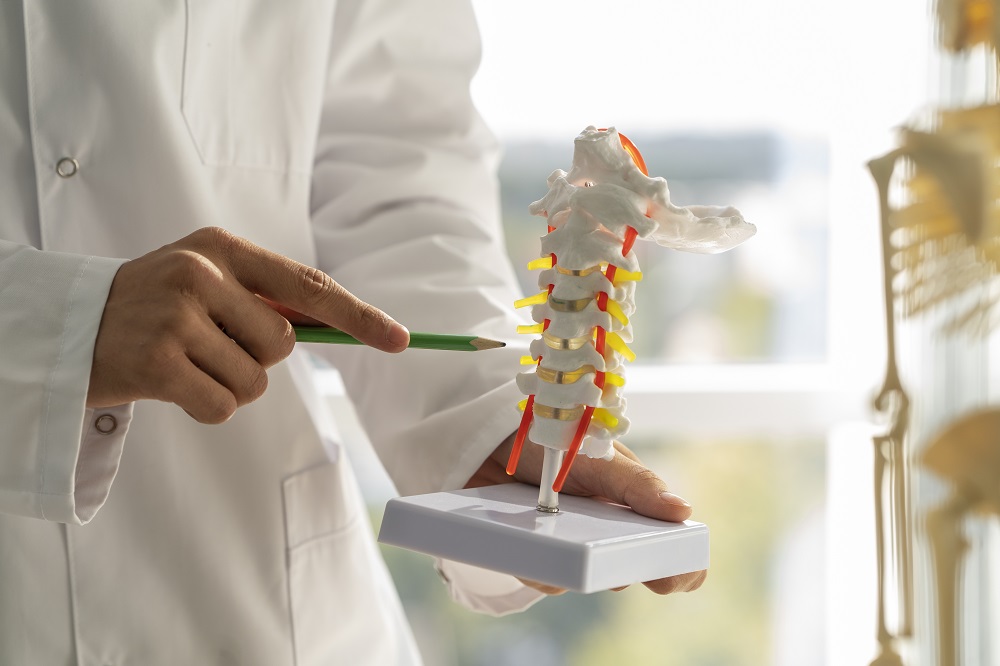
The spinal cord is the main conduit of the nervous system: it transmits commands from the brain to the muscles and returns sensory information from the body to the brain. When a spinal cord injury occurs—due to trauma, disease, or malformation—this communication is partially or completely interrupted below the level of the injury, resulting in loss of movement, sensation, and sphincter control.
In Spain, approximately 800-1,000 new spinal cord injuries occur each year. The most frequent causes are traffic accidents, falls, and sports accidents. A spinal cord injury radically changes one’s life, but with appropriate rehabilitation, it is possible to regain a significant degree of independence and quality of life.
Types of spinal cord injury
Depending on the level of the injury
- Tetraplegia (or quadriplegia): cervical injury affecting all four limbs and the trunk
- Paraplegia: thoracic, lumbar, or sacral injury that affects the lower limbs
According to the degree of impairment (ASIA scale)
- Complete lesion (ASIA A): there is no motor or sensory function below the level of the lesion
- Incomplete lesion (ASIA B, C, D): there is some sensory or motor preservation below the lesion
Incomplete injuries have a much more favorable prognosis for recovery. Even in complete injuries, rehabilitation allows for maximizing preserved functions and greatly improving quality of life.
What can be recovered after a spinal cord injury?
The question every family asks at the beginning is: Will they ever walk again? The answer depends primarily on the type and severity of the injury, whether it is complete or incomplete, and the time elapsed before rehabilitation began. But mobility is just one of the many aspects that spinal cord rehabilitation addresses .
- Motor function: strength, coordination, and control of preserved muscles
- Gait: Many patients with incomplete injury regain the ability to walk
- Upper limb function: crucial for autonomy in quadriplegics
- Bladder and bowel control: through sphincter management and rehabilitation techniques
- Prevention of complications: bedsores, urinary tract infections, spasticity, pain
- Wheelchair autonomy: handling, transfers, environmental adaptation
| Neuroplasticity and spinal cord injury: reasons for optimism • The central nervous system has the capacity to reorganize itself even after severe injury • Incomplete injuries have a very significant recovery potential • Early and intensive rehabilitation is the most determining factor in prognosis • New technologies (exoskeletons, electrical stimulation) are expanding the possibilities • Research in stem cells and spinal cord stimulation opens new perspectives |
Phases of rehabilitation in spinal cord injury
Acute phase (hospitalization)
Rehabilitation begins in the hospital itself, within the first few days after the injury. The goals at this stage are to prevent complications (bedsores, thrombosis, respiratory infections), maintain range of motion, begin strengthening the preserved muscles, and prepare the patient for the active rehabilitation phase.
Subacute phase (intensive rehabilitation)
This is the phase with the most intensive rehabilitation work. Ideally, it takes place in a specialized spinal cord injury unit. The goals are to maximize motor and sensory recovery, retrain basic functions (bed mobility, transfers, wheelchair use, walking if possible), and promote independence in activities of daily living.
Maintenance and community phase
Once the patient returns home, ongoing outpatient rehabilitation is essential to consolidate progress, prevent deterioration, and continue improvement. Home adaptation and social and occupational reintegration are key objectives of this phase.
Specific rehabilitation techniques for spinal cord injury
Neurological physiotherapy
Strength training of preserved muscles, gait retraining (with body weight support on a treadmill or with robotic exoskeletons in selected cases), balance and coordination training, treatment of spasticity.
Occupational therapy
Essential for regaining independence in daily living activities: dressing, grooming, eating, writing. In quadriplegics, hand and arm function work can make the difference between total dependence and independent living.
Respiratory rehabilitation
In high cervical spine injuries, the respiratory muscles may be affected. Respiratory physiotherapy is essential to prevent pulmonary complications and improve ventilatory capacity.
Sphincter rehabilitation
Bladder and bowel management are among the aspects that most significantly affect the quality of life of individuals with spinal cord injuries. Specific rehabilitation includes intermittent catheterization techniques, management of neurogenic bowel, and pelvic floor muscle training when possible.
Spinal cord injury and a full life: the goal of rehabilitation
The goal of spinal cord injury rehabilitation is not solely to restore walking ability. Its aim is to enable individuals to live as fully, independently, and integrated a life as possible. Many people with spinal cord injuries work, have families, participate in adapted sports, and lead fulfilling lives.
At Rehabot, we support patients with spinal cord injuries and their families at every stage of this process, with a team specializing in neurorehabilitation and with the conviction that there is always something that can be improved.